How to Choose the Right College: A Complete Guide for Students

Introduction
Choosing a college is one of the most important decisions you'll make as a student. The right college can provide quality education, valuable networking opportunities, industry exposure, and a strong foundation for your future career.
However, many students select colleges based solely on rankings, advertisements, peer influence, or location without evaluating what truly matters.
This guide will help you make an informed decision and choose a college that aligns with your academic goals, career aspirations, and budget.
Why Choosing the Right College Matters
Your college impacts:
The quality of education you receive
Internship and placement opportunities
Industry exposure and networking
Skill development
Higher education prospects
Career growth
A good college doesn't guarantee success, but it can provide the environment and resources needed to achieve your goals.
Before selecting a college, ask yourself:
What career am I interested in?
Which course will help me reach that goal?
Do I plan to pursue higher studies later?
Do I want immediate job opportunities after graduation?
Choosing a college becomes much easier when you know where you want to go.
For example:
Future AI Engineer → Look for strong AI, Data Science, and Computer Science programs.
Future Business Professional → Evaluate MBA pathways and business schools.
Future Designer → Focus on design-focused institutions and portfolios.
Always check whether the college is approved by relevant authorities.
Important accreditations include:
UGC Recognition
AICTE Approval
NAAC Accreditation
NBA Accreditation (for technical programs)
A recognized degree carries greater value during job applications and higher education admissions.
Do not choose a college solely based on its brand name.
Instead, examine:
Curriculum relevance
Industry-focused subjects
Practical learning opportunities
Research facilities
Updated technologies taught
A modern curriculum often matters more than a famous name.
Placement data provides insights into career opportunities.
Look for:
Placement percentage
Average salary package
Highest package
Recruiting companies
Internship opportunities
Focus on realistic averages rather than marketing headlines.
Questions to ask:
How many students were placed last year?
Which companies recruited?
What was the average salary offered?
Higher fees do not always mean better outcomes.
Calculate:
ROI = Career Opportunities + Placement Quality + Learning Experience ÷ Total Cost
Consider:
Tuition fees
Hostel fees
Living expenses
Additional academic costs
Choose a college that provides strong value for the investment.
Faculty play a significant role in your educational experience.
Research:
Faculty qualifications
Industry experience
Research contributions
Student reviews
A strong faculty team often translates into better mentorship and learning outcomes.
Visit the campus if possible.
Check:
Classrooms
Laboratories
Libraries
Wi-Fi facilities
Innovation centers
Sports facilities
Student activity clubs
Good infrastructure supports both academic and personal growth.
Location affects:
Internship opportunities
Industry exposure
Cost of living
Networking opportunities
Colleges located near major business and technology hubs often provide better access to industry experiences.
However, location should not be your only deciding factor.
Current students and alumni can provide valuable insights that marketing brochures cannot.
Look for:
Student satisfaction
Campus culture
Faculty support
Placement experiences
Alumni success stories
Platforms like LinkedIn can help you track where graduates are working today.
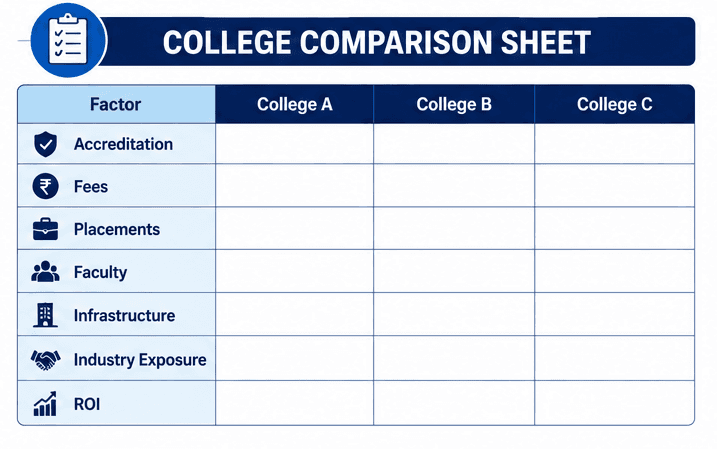
Create a comparison sheet including:
Factor College A College B College C
Accreditation
Fees
Placements
Faculty
Infrastructure
Industry Exposure
ROI
Comparing colleges objectively reduces emotional decision-making.
Common Mistakes Students Make
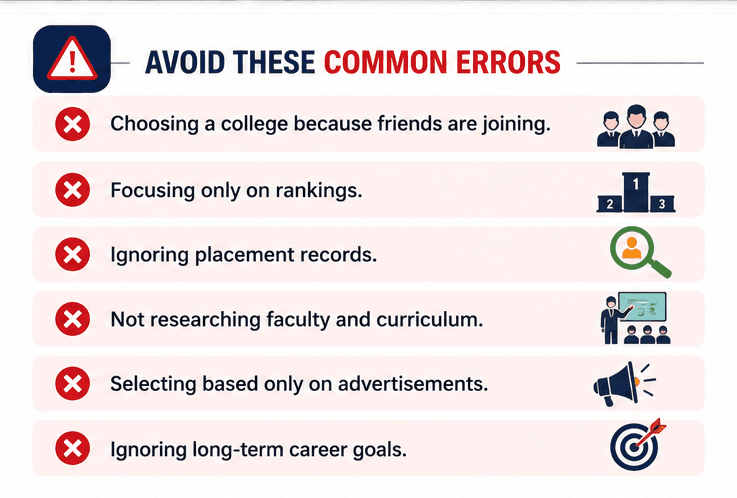
Avoid these common errors:
❌ Choosing a college because friends are joining.
❌ Focusing only on rankings.
❌ Ignoring placement records.
❌ Not researching faculty and curriculum.
❌ Selecting based only on advertisements.
❌ Ignoring long-term career goals.
Questions to Ask Before Finalizing a College
Before accepting admission, ask:
Is the college recognized and accredited?
Does the curriculum match industry needs?
What are the placement statistics?
Can I afford the total cost?
Are there internship opportunities?
Does this college support my long-term career goals?
If the answers are positive, you're likely making a strong choice.
Final Thoughts
The best college is not necessarily the most famous or expensive one. It is the institution that aligns with your career goals, learning preferences, financial situation, and future aspirations.
Take time to research, compare options, speak with mentors, and evaluate colleges objectively. A well-informed decision today can significantly impact your opportunities tomorrow.
If you're confused about choosing the right college, professional career guidance can help you identify the best institutions based on your goals, interests, and budget.
Need help choosing the right college?
Connect with EduWala's career experts and receive personalized guidance tailored to your academic and career aspirations.